The score(s) next to each publication’s review and the average rating is an interpretation of the reviews by Literature’s Pretty Long History.
Critics:
“We must here conclude our subject, but not without reccommending our readers to peruse the great Whale Epic of Herman Melville—certainly one of the most curious, instructive, imaginative, and graphic books of the present day.”
Supplemental Notice(s)
“And in Fiction, can we produce any sea novels equal to those of Cooper and Herman Melville?” — Eliza Cook’s Journal (June 19, 1852) and Portland Transcript (August 14, 1852)
“Is there not a solitary whale left, whose cetaceous biography might have added another stone to the monumental fame of the author of Moby-Dick?”
“But from the time that Typee came from Mr. Melville’s portfolio, he seems to have been writing under an unlucky star. The meandering nonsense of Mardi was but ill atoned for even by the capital sea-pieces of Redburn and White Jacket; Moby Dick proved a very tiresome yarn indeed, and as for the Ambiguities, we are compelled to say that it seems to us the most aptly titled volume we have met with for years.”
“’Omoo, or Adventures in the South Seas,” appeared in 1847, and was also published by Murray. In 1849, Mardi, and a voyage thither,” and ‘Redburn, or the Adventures of a Son of a Gentleman,” were published; in 1850, ‘Whitejacket, or the World in a Man-of-War;’ and in 1851, ‘Moby Dick, or the Whale.’”
Reprinted by Cummings’ Evening Bulletin (August 28, 1852)
“The rev. gentleman then proceeded to prove the absurdity of persons like Herman Melville, author of a book on whales, and Madame Peiffer, telling in their works how the missionaries should act, and pretending to describe the state of missionary operations, when perhaps they had not been at an island more than two or three weeks; and ascribed the massacres of white men which had taken place among the natives (mentioning the case of the Rev. J. Williams) to the fact that the poor untutored fellows had been studiously and systematically robbed of their sandal wood, and that consequently they took all white men for enemies and dealt with them accordingly.”
“The lady, with her disengaged hand, rapidly sought that woman’s weapon, a pin, but finding none, took from her shawl the silver arrow which fastened it at her throat, and with all the gusto of one of Melville’s whalers after “Moby Dick,” plunged the arrow of punishment deep into the kind gentleman’s arm, causing him to withdraw it with as much rapidity as was convenient.”
“Every one who was ever in any way concerned in the taking of fish will acknowlege its facination, from the school-boy with his pin – hook and thread patiently endeavoring to obtain a “glorious nibble” from coy mummychaug, up to the stalwart Nantucketer, as he buries a lance in the broad side of some leviathan of a Moby Dick.”
“A very good friend of ours recently placed upon our table a copy of “Moby-Dick,” a work by that popular author, Herman Melville. From it we make a few excerpts, which we pencilled while passing hastily through its pages.”
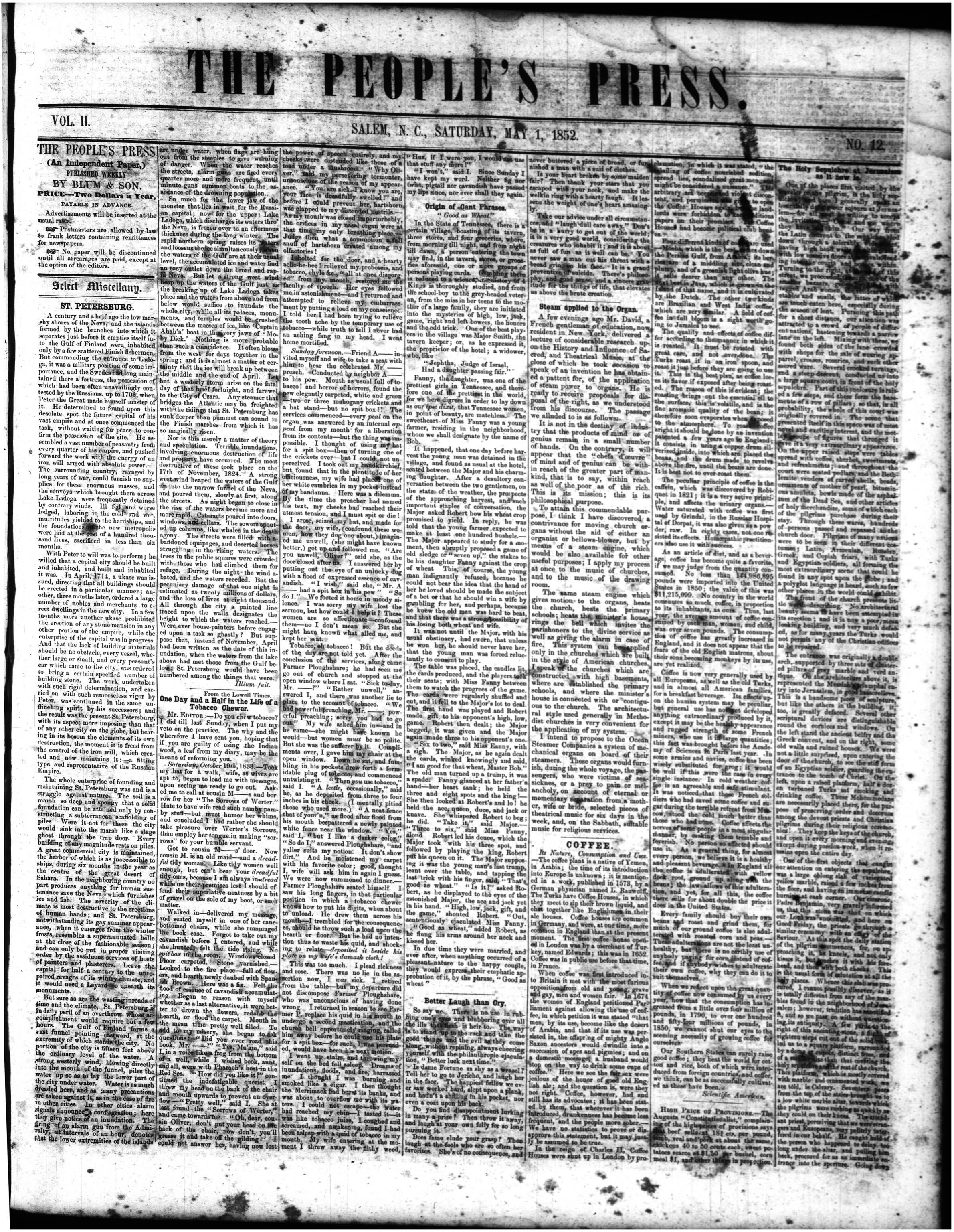
“But let a strong west wind heap up the waters of the Gulf just as the breaking up of Lake Ladoga takes place, and the waters from above and below would suffice to inundate the whole city, while all its palaces, monuments, and temples would be crushed between the masses of ice, like Captain Ahab’s boat in the ivory jaws of ‘Moby Dick.’”
Reprinted by The Key Stone (April 14, 1852), The Sailor’s Magazine (May 1852), The Western Sentinel (May 1, 1852), The People’s Press (May 1, 1852), (April 3, 1852), Camden Journal (April 9, 1852), Family Mirror (June 19, 1852), and The Pacific (July 2, 1852)
“DOMESTIC FELICITY OF THE WHALE”
“But badinage apart, this book, strange as it is, contains some scenes of stirring interest; and scattered through its motley pages the reader will find more curious and varied information about the whale, its habits, manners, morals, oil, blubber, feeding, swimming, mode of chasing, and harpooning, and cutting up, than in any other treatise, probably extant.”
“There is another of the attractive series of sea stories, by Mr. Melville, which embraces, “Typee,” “Omoo,” “Redburn,” “Mardi,” &c.”
“This is what is called a compact volume of upwards of six hundred pages, all about ‘the whale,’ whalers, and whaling, being itself a perfect literary whale, and worthy of the pen of Herman Melville, whose reputation as an original writer has been established the world over.”
“This volume sparkles with the raciest qualities of the author’s voluble and brilliant mind, and whatever may be its reception among old salts, it will be sure of success with the reading public generally.”
“The author of “Moby Dick,” (who tells some stories “very like a whale,”) will have to knock under to the following from the Boston Post Boy of Oct. 14, 1771:”
“For the adventures of Mr Green with this marvellous conger, this “Moby Dick” of Worthing, we must refer our readers to the New Monthly itself.”
“We must here observe that there is a race of writers in the present age of literature gifted with sufficient originality, who are nevertheless not content to exhibit these qualities naturally, but must needs display themselves as the fanatics of fact or fiction, romance or philosophy, history or metaphysics, poetry or novel writing. Among these we reckon Carlyle, Tennyson and Disraeli, Dumas and George Sand. In the present instance, the author, who might have given us a rational and yet sufficiently exciting story, without being strained, supernatural and ridiculous, has been pleased to write a rhapsody painful in its elaboration and absurd in its conduct.”
“It should have been given as an episode by Mr. Herman Melville in his romance entitled the Whale.” — British Army Despatch (March 12, 1852)
“LIFE IN A SOUTH SEA WHALER”
““The Whale” is not the least remarkable work of a very remarkable writer.”
“There are enough fine and valuable passages in it to amply repay its perusal.”
Average Rating
Latest